


Namibia Landscape & Wildlife Photography Portfolio
Explore the otherworldly beauty of Namibia through Will Gray's collection of images documenting the country's arid environments and resilient wildlife. Grounded in over 35 years of professional field craft, these photographs capture the dramatic interplay of light and shadow across Africa’s most iconic desert landscapes.
Featured Namibian Landscapes & Regions


Deadvlei, Sossusvlei & The Namib Desert
Witness the striking geometry of Africa's most iconic desert, where ancient clay pans meet towering apricot dunes. This gallery captures the dramatic interplay of light and shadow sweeping across the vast Namib Desert. From the stark, skeletal silhouettes of 900-year-old camelthorn trees in Deadvlei to the shifting ridges of Dune 40, these images explore a minimalist wonderland.


How to Photograph Deadvlei
Namibia lures photographers with its vast, minimalist landscapes and rich light. Wildlife thrives in Etosha, while the coast offers moody, fog-wreathed seascapes. But if there’s a ‘classic’ shot to be taken in Namibia, it’s probably at Deadvlei. This remote clay plan, dotted with the skeletons of 900-year-old camelthorn acacias, has become one of Africa’s poster pin-ups. It’s become so well photographed that finding an original interpretation is becoming increasingly difficult. Here’s how I’ve approached it over the years…
First-timers need to understand that Deadvlei is all about the light. Stay at Sesriem so you can enter the park at least an hour before sunrise – or, better still, book a room at Sossus Dune Lodge inside the park. From the Sossusvlei car park it’s a 5km 4WD track, followed by a 20-minute walk.
Early on, the dunes glow orange while the clay pan stays cool and pale. A large dune (Big Daddy) casts a diagonal shadow across the vlei, creating a clean, graphic backdrop for tree silhouettes. Start with trees at the far edge of Deadvlei; they lose silhouette first as sunlight creeps across the pan. A wide-angle lens (16-35mm) is ideal for including rich foreground detail, like sun-cracked clay, while a telephoto (70-200mm) can be used to isolate individual trees with strong character, or pairs that ‘reach’ towards each other.
Exposure needs care. Spot-meter the sunlit dunes to let the trees fall into silhouette, or dial in –1 to –2 stops of exposure compensation. Keep ISO low and apertures around f/11 for decent depth of field – and use a tripod to help you frame more carefully-considered compositions.
Finally, don’t be in too much of a rush to leave. An hour or two after sunrise, I find that something equally captivating happens with the light. By then, it has flooded most of the pan and you’ve lost the soft richness of sunrise – but the white clay surface acts like a giant reflector, bouncing light back up into the trees. At this point I actually turn to shoot into the light and over-expose by +1 or +2 to reveal the extraordinary effect this has on the acacias. It looks as if they’ve been turned into bronze statues.
Spitzkoppe, Twyfelfontein & Damaraland
Journey into the ancient, rugged heart of Damaraland, a landscape shaped by millions of years of geological time. This photographic collection highlights the spectacular granite peaks of Spitzkoppe — often called the Matterhorn of Africa — and its dramatic natural rock arches. The imagery moves deeper into the rust-red wilderness to reveal rare desert-adapted wildlife .


Etosha National Park & Onguma Reserve
Experience intimate wildlife encounters captured from the edge of Namibia’s great white salt pan. This gallery documents the resilient animals of Etosha National Park and the neighboring Onguma Reserve, showcasing life in a hyper-arid ecosystem. Utilizing specialized low-angle hides, the collection brings you eye-to-eye with lions, elephants, rhinos, and zebras gathered around desert waterholes.


Walvis Bay, Sandwich Harbour & The Skeleton Coast
Explore the moody, fog-wreathed transition between giant desert dunes and the wave-pummeled Atlantic Ocean. This gallery spans the treacherous beauty of the Skeleton Coast and the bustling wildlife havens of Walvis Bay. The photographs capture contrasting environments, from thousands of pink flamingos and play-fighting Cape fur seals to the rusting remains of shipwrecks.


The Kalahari Desert & Quiver Tree Forest
Discover a surreal world of succulent trees and glittering night skies on the western fringes of the Kalahari. This collection centres on the striking candelabra silhouettes of the Quiver Tree Forest near Keetmanshoop. The portfolio captures the golden, peeling bark of these ancient botanical wonders by day and frames them against the celestial arch of the Milky Way by night.


How to Photograph the Quiver Tree Forest
They’re succulents, not trees, but botanical nomenclature is the last thing on your mind as you wander beneath the candelabra crowns of this surreal swathe of quiver trees studding a dolerite ridge not far from the town of Keetmanshoop. You’ll be dizzy… your head spinning from tree to tree, trying to decide which one to photograph.
I often approach woodland photography in the same way I might tackle a street scene crammed with people. Pick out an individual with character. In the case of quiver trees, that might be one with a quirky array of branches or a particularly intense shade of peeling, golden bark. Look for ‘companion trees’ – one leaning towards the other perhaps. Or get down low to frame the star-shaped clusters of fleshy fronds against a deep blue sky. Viewpoint is also crucial if you’re attempting a night shot. Scout out trees on slight rises or sprouting from rocky outcrops so you can isolate them from the crowd and maximise your view of the sky – ideally garnished with the glittering arch of the Milky Way.
The nearby Giant’s Playground has far fewer quiver trees, rising like exclamation marks from a vast jumble of boulders. Place one on a line-of-thirds and strong compositions will leap out at you. Look harder and you will find lead-in lines created by cracks in the dolerite. Or zoom in for simplified scenes that explore the strong geometry of stacked boulders.
Kolmanskop Ghost Town & Luderitz
Step inside a fading diamond-mining town being slowly reclaimed by the shifting sands of the Namib. This evocative gallery explores the eerie interior spaces of Kolmanskop, an abandoned ghost town frozen in time. Photographed during the soft, low light of dawn, these images reveal wind-combed sand dunes oozing through doors and windows. The collection captures the melancholic beauty of peeling wallpaper, cracking woodwork, and historical coastal architecture under the moody Atlantic fog.


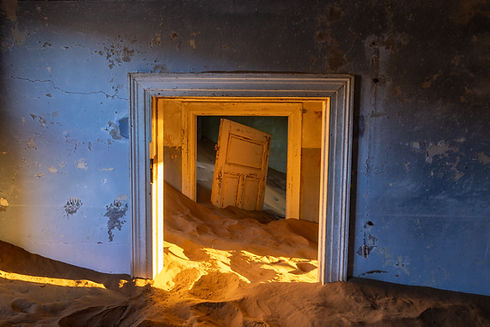
How to Photograph the Diamond-mining Ghost Town of Kolmanskop
Abandoned in the mid-1950s, the former diamond-mining town of Kolmanskop, near Luderitz, offers rich pickings for photographers. The desert is slowly digesting the derelict buildings, sand oozing through windows and doors, but there’s enough left – from fading wallpaper to rusty wash basins – to create an eerie connection to the past. Get there early, brandishing a dawn photography pass, which you can purchase onlne, or in Luderitz the day before. Not only will you avoid the crowds (and hopefully have smooth, wind-combed sand, free from footprints, inside the buildings), but the rising sun creates interesting shadows and textures as it rakes the sand ripples, peeling paint and knotted wood. Don’t despair if it’s foggy – the muted, softer light minimises contrast, making exposure less of a headache And, of course, there’s nothing more ghostly-looking than a ghost town in the fog.
Namibia Photography FAQs
- 01
- 02
- 03