


Why I Love Namibia

Photographer and travel writer Will Gray recounts 30 years of unforgettable adventures in Namibia, and attempts to pinpoint what it is about this hot, arid country that keeps drawing him back...

Why I love namibia? First impressions...
I first got Namibian sand between my toes nearly 30 years ago, and it’s remained there – at least metaphorically – ever since. It never surprises me that Namibia frequently jostles with New Zealand, Alaska and other wilderness heavyweights when we’re asked to vote for our favourite destination. Namibia is a traveller’s utopia: wild and rugged yet riddled with self-drive potential; a country so captivating and brimming with adventure, wildlife, epic landscapes and ancient culture that it quickly pervades your itinerary, stretching it thin. Two weeks become three; one visit becomes two. Before you know it, Namibia has wrapped you in its sandy embrace and won’t let go.

An eagle's eye view
I vividly remember my first trip back in 1996. My assignment – covering one of the legendary Skeleton Coast Safaris – involved flying in a Cessna along much of Namibia’s desert shore and arid hinterland. Even now, I can picture my pilot and guide, Andre Schoeman, hunched like a bear over the joystick, chewing toffees, his sun-creased eyes twinkling beneath a tartan baseball cap.
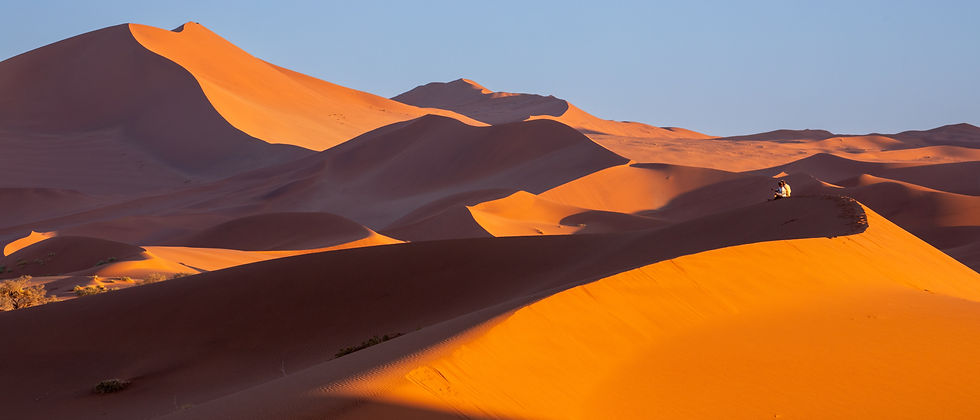
One moment sticks in my mind: the Namib-Naukluft dune field spread below us like a mountain range of soft-whip butterscotch ice-cream as we flew west across the heart of the desert. Andre pointed the nose of the Cessna to the horizon; the dunes started to flatten, as if someone had tugged the folds from the edge of the desert, and then salt pans – blinding white, stamped with the crisp shadow of the Cessna – were streaking past barely 50ft below us. A row of dunes, a beach, waves breaking, water churned to foam – and seals! Seals in their hundreds, leaping and twisting, somersaulting from the curling green walls of Atlantic breakers. Banking on a wingtip, we stared down at the deep cobalt of the ocean, streaked with creamy froth. Glistening brown stems of giant kelp looped above the surface like the arms of cavorting sea monsters. Andre levelled the Cessna and we flew north, low and fast above the waves of the Skeleton Coast.
Later that day, we turned inland, a tiny fly buzzing the raw, wrinkled hide of a primeval land; fussing over the shrivelled sinews of desiccated riverbeds and finally alighting on a deserted gravel plain, surrounded by the fleshy hulks of rust-coloured monoliths.
It wasn’t simply the grandeur of Namibia’s landscapes that struck me during that unforgettable flying safari – it was its overwhelming sense of antiquity. “This place is like a book,” Andre told me one morning as we walked slowly across boulder-strewn foothills near our camp. He pointed out a large, shiny rock that had been polished smooth by the constant rubbing of zebra, gemsbok and rhino over thousands of years. Later he showed me a stone scraper and quartz sling shot from a Bushman’s toolkit, and painted images of hunters striding across the walls of a rocky shelter, faded by time, like a distant memory.
Life in the desert
On another trip, I drifted in a hot-air balloon near Sossusvlei, mesmerised by dawn sunlight sparking off the 300m-tall dunes. The world’s driest and most ancient desert, the Namib was spawned by the relentless waves of the Skeleton Coast some fifty million years ago. If enough rain falls on the mountains to the east, the Tsauchab River springs to life, a flash flood tearing through Sesriem Canyon before surging along the Corridor. But the rejuvenated river never reaches the coast. At Sossusvlei it is choked by an immense sand sea. On the rare occasions when the vlei, or clay pan, is full it forms an ephemeral oasis teeming with flamingos, dragonflies and frogs.
The tenacity of Namibia’s wildlife never fails to amaze me. I’ve seen jackals scouring the strandline of the Skeleton Coast, squabbling over dismembered gull wings and rotten fish, and I’ve watched desert elephants scuffing dry riverbeds in Kaokoland, tapping into memories of hidden, subterranean water. During one visit, driving along the Caprivi Strip, I remember stopping to help dozens of migrating chameleons cross the road, fearful that they’d be squashed by trucks thundering towards Kasane. You only have to stake out a waterhole in Etosha, watching fretful herds of thirsty springbok – constantly wary of lions waiting in ambush – to appreciate how finely balanced life is in this parched land.
The human touch
People have adapted to its harshness too. Travelling with my wife and six-year-old twins, we once spent several days with the Ju/’hoansi (‘Dju-kwa-si’) Bushmen who live in Namibia’s remote northeast. The largest remaining, most traditional of the Bushmen groups, uncontacted by the outside world until the 1950s, it was a humbling, poignant and fascinating insight into one of the world’s most persecuted and threatened cultures. They showed us how to hunt spring hares; to squeeze moisture-laden shavings from kambro tubers, and tap into the honeycombs of bee nests by inserting long stalks of elephant grass. My children made Ju/’hoansi friends by racing caterpillars along branches and threading tiny discs of ostrich shell into simple necklaces.
Another reason why I love Namibia is that it is supremely family-friendly. On the same trip, our twins ran barefoot as they flew kites above the sands of the NamibRand, while the giant dunes of Sossusvlei became the ultimate roly-poly.
A rollercoaster ride
We’ve also been taught harsh lessons in Namibia: a moment’s lapse in concentration driving along a gravel road towards Fish River Canyon resulted in my wife and I rolling our car. Luckily, we crawled unscathed from the wrecked Nissan and help arrived shortly after the accident. On that particular trip, we retreated south, towards the Northern Cape Province – meandering slowly through Namaqualand and the Cederbergs. This wild corner of South Africa is another of my favourite destinations. With enough time, I would always prelude a Namibian adventure by driving north from Cape Town towards the Orange River. But if I had to choose between the two, then Namibia would edge it. Right now, I can’t think of any trip I’d like to do more than to pack my belongings into a Land Rover with a rooftop tent and lose myself for a week or two in the ancient, rust-red, big-sky country of Damaraland and the Namib Desert.
This article was originally published in Travel Africa magazine
Join me in Namibia
I now run photography adventures in Namibia. With small groups of just seven, they include everything from accommodation in camps and lodges and transport in a 4WD minibus to activities such as desert elephant tracking, sea kayaking with seals, photographing the Milky Way and watching wildlife in Etosha. Visit my website for full details and to reserve your place for 2027 (all departures in 2026 are sold out).


Comments